

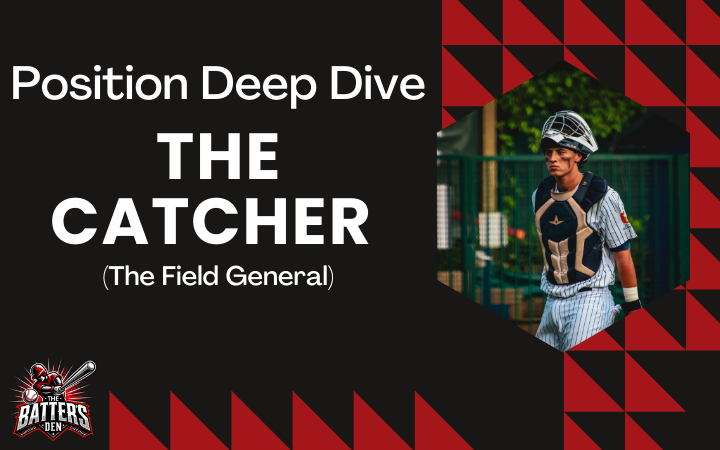
There is only one player on the baseball field who sees the game in reverse.
While everyone else looks in at the batter, the Catcher looks out at the field. They are the only player involved in every single pitch, every defensive alignment, and every strategic decision.
They are the “Field General.”
Catching is widely considered the hardest job in sports. It requires the durability of a linebacker, the soft hands of a pianist, and the strategic mind of a chess master. It is grueling, thankless, and often painful.
But if you are the type of player who wants to control the game, there is no better place to be.
The Job Description (What do they actually do?)
Most people think a catcher’s job is just to catch the ball and throw it back. That is about 10% of the job. The real work happens in three specific areas:
- Receiving (Making Strikes Look Like Strikes) The umpire decides the strike zone, but the catcher influences it. “Framing” (or receiving) is the art of catching a borderline pitch and making it look like a strike without being obvious about it.
- The Goal: Steal strikes for your pitcher. If you can turn a 1-1 count into 1-2 instead of 2-1, you change the entire at-bat.
- Blocking (The Wall) Nothing frustrates a pitcher more than a passed ball. A catcher must be willing to drop to their knees and take a ball off the chest protector to keep a runner from advancing.
- The Goal: Keep the double play in order. If the ball gets by you, the runner moves up, and the force out is gone.
- Controlling the Run Game This isn’t just about throwing runners out. It’s about being quick enough with your transfer (getting the ball from glove to hand) that runners are afraid to even try to steal.
The Profile: Who Belongs Behind the Dish?
Not every athlete is built for this. If you are thinking about moving behind the plate, you need an honest assessment of your tools.
The Physical Tools:
- Durability: You are going to do 100+ squats per game. If you have weak knees or tight hips, you will not survive the season.
- Agility > Speed: Catchers don’t need to run a 6.5 sixty-yard dash. They need explosive lateral movement (side-to-side) to block balls in the dirt.
- The “Short” Arm: Outfielders have long, looping throws. Catchers need a short, compact arm action (ear-to-ear). The ball needs to be out of your hand in under 0.7 seconds.
The Mental Tools (The Secret Sauce):
- Toughness: You are going to get hit by foul tips. You are going to get bruised. You have to be okay with that.
- Selflessness: Your ERA doesn’t matter. Your batting average is secondary. Your job is to make the pitcher look like a Cy Young winner. If the pitcher struggles, you take it personally.
- High IQ: You need to know the situation (outs, count, runner speed, hitter tendencies) better than anyone else on the field.
The Toolbox: What to Train
If you want to be a catcher, stop hitting for a second. The quickest way to get on the field is defense.
- Hip Mobility If you cannot sit in a deep squat comfortably with your heels flat, you cannot catch effectively.
- Drill: Daily deep squat holds and hip internal/external rotation stretches.
- Hand Strength When an 80mph fastball hits your glove, does your hand drift back? If so, it looks like a ball. You need the strength to “stick” the pitch right where you caught it.
- Drill: Weighted ball receiving drills and forearm grip training.
- The Transfer Pop time (the time from the pop of the mitt to the pop of the fielder’s glove) is mostly about the transfer. A strong arm is useless if you fumble the grip.
- Drill: Rapid-fire transfer drills (glove to hand) without throwing. Focus on finding the seams instantly.
The Pro Study
Want to see perfection? Watch highlights of Yadier Molina or J.T. Realmuto.
Don’t watch the home runs. Watch how quiet their bodies are when they receive the ball. They don’t jerk around. They present a calm, steady target for the pitcher. Watch how they command the infield, moving defenders with a subtle point of the finger. That is true leadership.
The Bottom Line
Catching isn’t for everyone. It hurts. It is tiring. It requires a special kind of grit.
But catchers are the fastest players to be recruited because they are so rare. If you have the hips, the hands, and the heart to lead the defense, the game needs you.
Ready to put on the gear? Catching is a highly technical position that requires specific coaching to avoid injury. Book a session with our catching instructors or sign up for our next Catching Clinic to learn the proper mechanics of receiving, blocking, and throwing.