

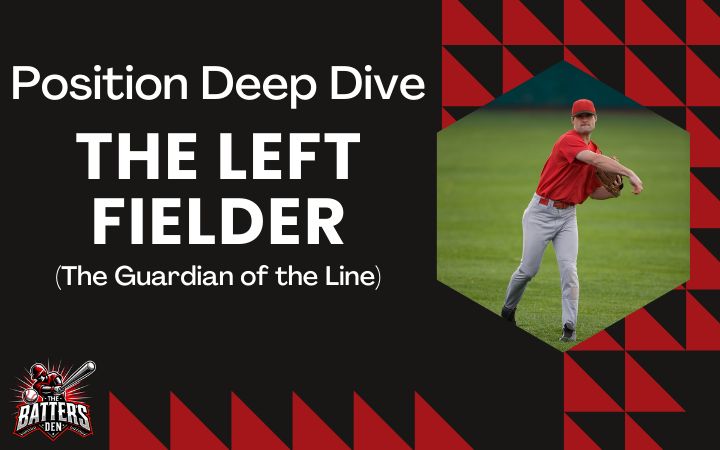
In Little League, you put your weakest player in Right Field. In the Big Leagues, you often put your biggest slugger in Left Field (think Barry Bonds or Manny Ramirez).
Because of this, Left Field gets a reputation as the “easy” outfield spot.
That is a dangerous myth.
At the high school and college level, the majority of hitters are right-handed. When they make solid contact, they pull the ball. That means the Left Fielder sees more “hot shots,” line drives with nasty topspin, and balls hooking toward the foul line than anyone else in the outfield.
You might not need the speed of a Center Fielder or the cannon arm of a Right Fielder, but you need the best glove and the smartest reads to survive out there.
The Job Description (The Hook & The Line)
Your job is to turn doubles into singles and triples into doubles.
- Reading the “Hook”: A ball hit to Left Field by a righty often has “hook spin”—it curves toward the foul line. If you run straight at it, it will curve past you for a double. You have to read the spin instantly.
- The Foul Line: You are the goalie. If a ball gets past you down the line, it rolls into the corner for extra bases. You have to take angles that cut the ball off before it reaches the warning track.
- Backup Duty: Anytime a ball is thrown from Right Field or Center Field to Third Base, you are sprinting to back up the throw. If the ball gets past the Third Baseman, you are the only thing stopping the runner from scoring.
The Profile: Who Belongs in Left?
The Physical Tools:
- Reliable Glove: You are going to get balls that are hit hard and low. You can’t bobble them.
- “Gap” Speed: You don’t need to cover as much ground as the Center Fielder, but you need enough range to cover the “Left Center Gap” so the Center Fielder doesn’t have to run 40 yards for every fly ball.
- Accuracy > Strength: You have the shortest throw to Third Base and Home Plate. You don’t need a cannon, but you need to be deadly accurate. Hitting the cutoff man is more important than showing off your arm.
The Mental Tools (The Anticipator):
- The Jump: Because the ball comes off the bat faster to the pull side, your first step is critical.
- Wall Awareness: Corner outfielders have to deal with weird bounces off the side walls or foul poles. You need to know your stadium.
The Toolbox: What to Train
If you want to own Left Field, you need to master the “slice.”
- Reading the Spin Have a coach hit line drives that hook toward the foul line. Practice taking a “J-Curve” route—running to where the ball will be, not where it is.
- Drill: “Hook Drills.” Start in a neutral stance. Coach hits hooking liners. Work on opening your hips toward the line without drifting into foul territory too early.
- Playing the Hop Left Fielders get a lot of hard ground balls (singles). You need to charge them aggressively to keep the runner from taking an extra base.
- Drill: “Do-or-Die” ground balls. Charge hard, field outside your glove foot, and come up throwing.
- The Wall Ball Every fence is different. Chain link dies; padding bounces. You need to know how the ball plays off the corner.
- Drill: Throw balls against the wall at odd angles and practice reading the carom.
The Pro Study
The Gold Standard: Alex Gordon. He won Gold Glove after Gold Glove because he took perfect routes. He rarely had to dive because he read the ball so well off the bat.
The Modern Wizard: Steven Kwan. He isn’t the biggest guy. He doesn’t have the strongest arm. But he is fearless. He plays the “Green Monster” (or any wall) perfectly and never gives up on a play.
The Bottom Line
Left Field isn’t a vacation spot. It’s where the hardest hits go.
It requires a cerebral player who understands spin, angles, and geometry. If you have a trusty glove and high baseball IQ, you can dominate this position.
Master the Angles. Do you struggle reading the ball off the bat? The Outfield Clinics at The Batter’s Den focus on reading spin, route efficiency, and “wall awareness.”