

It happens every single summer. A talented, hard-working high school athlete narrows their entire recruiting focus down to a single goal: a Division I offer. They want the flashy gear, the massive stadium, and the social media clout that comes with committing to a big-name program.
We get it. It’s an incredible achievement. But the modern recruiting landscape, heavily impacted by the transfer portal, has made high school D-I spots brutally difficult to secure. More importantly, committing to a D-I program just to say you did it often means spending four years riding the bench while an older transfer takes your reps.
At The Batter’s Den, our coaching staff has played, scouted, and coached across every level of the college game. We know a hard truth that many parents and players overlook: the best development happens on the field, not in the dugout.
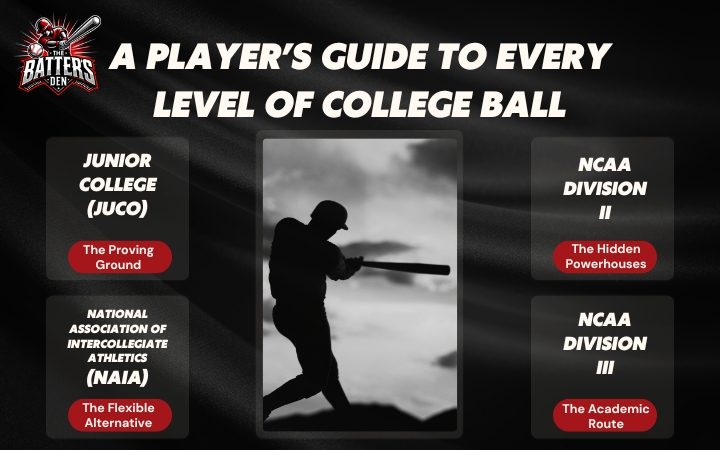
Finding the right fit means understanding all your options. Here is your playbook for the reality of JUCO, NCAA D-II, NCAA D-III, and NAIA baseball and softball.
Junior College (JUCO): The Proving Ground
The ultimate destination for late bloomers, raw athletes, and players who just want to grind.
Junior college baseball and softball is not a fallback plan; it is a strategic launching pad. JUCO programs are two-year schools that offer athletes an immediate opportunity to step on the field and get significant reps against college-level pitching and hitting.
- The Development Fast-Track: If you are physically a late bloomer or need to clean up your mechanics, JUCO gives you two years of heavy development and game experience.
- The Transfer Advantage: Unlike four-year NCAA athletes who often face complex transfer rules, JUCO players can easily transfer into Division I or Division II programs after their freshman or sophomore year. College coaches love recruiting JUCO players because they are battle-tested and physically mature.
- The Culture: JUCO is gritty. You will carry your own gear, take long bus rides, and learn what it actually means to work for your spot.
NCAA Division II: The Hidden Powerhouses
Elite competition with a better balance of athletics and academics.
Do not let the “II” fool you. Top-tier Division II baseball and softball teams are absolute wagons that routinely beat lower-level Division I programs in fall scrimmages. The game is incredibly fast, and the athletes are explosive.
- Athletic Money is Real: Division II programs offer athletic scholarships. While fully funded D-I programs divide their money among a large roster, a well-funded D-II program can often put together incredibly competitive financial packages for their top recruits.
- The Portal Impact: Many D-I athletes who get buried on the depth chart transfer down to D-II to get playing time. This means the talent pool at the D-II level is currently deeper and more dangerous than ever before.
- The Balance: D-II offers a slightly more balanced college experience, allowing student-athletes to pursue demanding academic majors (like nursing or engineering) that D-I schedules often make impossible.
NCAA Division III: The Academic Route
Where elite academics meet pure passion for the game.
The biggest myth in recruiting is that Division III means “not good enough for a scholarship.” The reality? D-III is packed with all-state high school players who prioritized their long-term future.
- The Financial Loophole: It is true that D-III programs cannot offer athletic scholarships. However, they make up for it with massive academic grants and leadership packages. If you have a high GPA and great test scores, a D-III package can often make your college experience cheaper than a D-I athletic scholarship would.
- True Student-Athletes: D-III is designed for the athlete who wants a world-class degree from a prestigious academic institution while continuing to play the game they love at a highly competitive level.
- Playing for the Love of It: Without athletic money hanging over their heads, D-III athletes are on the field strictly because they love to compete. The culture is pure, competitive, and highly rewarding.
NAIA: The Flexible Alternative
Smaller schools, huge opportunities, and fewer recruiting restrictions.
The National Association of Intercollegiate Athletics (NAIA) operates independently of the NCAA and is a massive, often-overlooked opportunity for high school athletes.
- Less Red Tape: The NAIA has far fewer recruiting restrictions than the NCAA. Coaches can communicate with you earlier, and the eligibility center process is generally more streamlined.
- High-Level Talent: The top 25 NAIA programs in the country play at a level comparable to elite Division II teams. You will see 90+ mph fastballs and devastating rise balls every single weekend.
- Scholarship Limits: NAIA programs are allowed to offer athletic scholarships, and because they are typically smaller private schools, they often stack athletic and academic money to make the financial package incredibly appealing.
The Bottom Line
A jersey is just a piece of fabric. The logo on the chest does not dictate your worth as an athlete, and it certainly does not guarantee your development. If you want to get better, you have to go somewhere that actually wants you on the field.
Stop guessing your way through the recruiting process. If you want to figure out which level is the perfect fit for your academic goals and athletic metrics, come into The Batter’s Den. Book a cage session, talk to our coaches, and let’s build a realistic, actionable plan to get you to the next level.